
With the prelims just around the corner, thinking about how best to prepare for them can be challenging when you’re not sure where to start. Below we have put together some helpful tips and advice on how to set yourself up for successful studying in the run up to this first set of exams that we hope you will find useful.
Ask questions! You’ll have all of your classwork and homework across many subjects so it can all feel
a bit overwhelming. You will be asked lots of questions in different classes: “How will this affect…?”,
“Does this help to explain…?”, as teachers try to help you with your learning. Think about asking
yourself these questions in class and as you study. This will develop your thinking skills and make you
more confident in understanding the ground you are covering. If you are ever uncertain about a
topic covered make sure to ask your teacher. They can perhaps explain it in a different way or direct
you to a study guide which lays things out differently.
Organise your course notes. There are many ways to organise your written work to make sure you
are taking it in and to get the most out of it when it comes time to go over it again.
Cornell notes are a system for taking, organising and reviewing notes. There are six sections or boxes you create to make a set of notes. The size of each box or section can vary, but it is more important that the format looks vaguely similar to the example shown to the left.
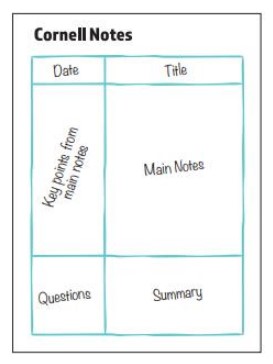
- Title (top right). This is really important for revision to ensure you have covered the entire course.
- Date (top left). The date when you wrote the notes so you can keep them in order chronologically.
- Main Notes (middle right). This is where you put the main thoughts or ideas as you read. Ideally this should be detailed and written in a way that is clearly understood when you are reading it back.
- Key Points (middle left). Just after you write the main notes, pick out the key points and jot them down here as short bullets. The bullets should be easily remembered and might only be one word.
- Questions (bottom left). This section of the notes is extremely useful. These are areas that aren’t quite clicking and you need to explore further or may be questions that you think of as you study. Your questions should never go unanswered as they take your learning to a deeper place.
- Summary (bottom right). Ideally, you shouldn’t be adding your summary on the same day that the notes were taken. Spend some time later on in the week or even at the beginning of the next week reading through your notes and summarising them in this box.
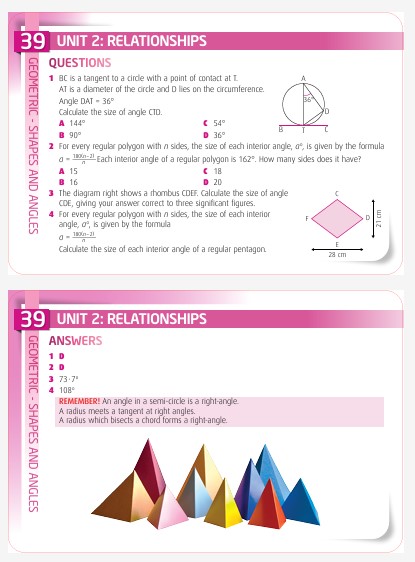
Flashcards are best used for going over topics that you have already learned. If you don’t understand a concept, read the chapter in the book again or watch a video explaining it first. A great habit to get into is using flashcards ‘live’ as you are learning to reinforce the information that you have just gone over. Flashcards are a fantastic tool for testing the gaps in your knowledge: at the start of a study session, give yourself a little test with your cards to identify what areas you should be focusing on.
BrightRED has some fantastic flashcard sets that cover all the key information you need to know; see what subjects we cover on our website here.
Brain dumps are very useful when learning something new. Pick a topic you want to cover and read
it through. Then simply using a blank page, write down everything you can remember. That’s it!
There are a few further ways in which you can use your finished brain dumps as you study.
You can look at your brain dump alongside the pages of the notes or guides and take note of the
things you forgot and go over that material again. You can also do a brain dump on the same topic a
day or two later and compare both to see what you are struggling to recall and then revisit that part
of the textbook. Both these techniques are putting an emphasis on material that didn’t go in the first
time. The process of really focusing on closely reading the topic chosen, and then trying to recall as much as possible right away is what makes the difference.

Dual coding is using different ways to represent the information that you are learning. A large proportion of most books are written as text, so useful things that you can do is take chunks of that text and recreate it in a different way; examples are using simple pictures in a mind map or cartoon strip, a sketch diagram, an infographic, a table or chart or a timeline. The science shows that combining text and images as we learn helps our understanding. Creating the images ourselves can also be a very powerful learning technique.
Mini quizzes are another straightforward technique. As you are reading through your notes, create a
mini quiz of 5-10 questions as you go along. Using an A4 piece of paper or opening a Word document, write your questions on one side and your answers on the opposite page. You can complete this at the end of the reading or give yourself a challenge by waiting for a day or two before completing your quiz.
Top tips.
- Switch between ideas as you study. Don’t switch too often, though, as you need to make sure you understand the idea before switching!
- Revising in a different order will also help you understand the information. The technical term for this is interleaving. Just because you have read something once doesn’t mean you will always remember it. That’s why learning how to recall and retrieve information is possibly more important than reading it for the first time.
- Space out your study and learning. The experts would say that four or five hours spaced over a week is much more beneficial that five hours in one day!
- Linked to the above point, be organised! Know what it is you have to learn and create a timetable for study. It is highly possible for students who are organised and in charge of their learning to jump up a few grades as they know exactly what they need to learn and have created the time and space to learn it.
- Find ways to represent the information for yourself. If there is text in this book you want to remember, then why not turn it into an infographic or a cartoon strip? Similarly, if you see a diagram, you can change it into text or bullet points.
GOOD LUCK!
We hope that the study advice we have put together here is useful for you as you get ready to sit the prelims towards the end of the year. Remember that all you can do is give it your best shot, and use it as an opportunity to see how you might improve your grades come the real exams in April. We’re wishing you all the very best of luck!
 Bright Red Publishing Blog