Gearing up for the prelims

With the prelims just around the corner, thinking about how best to prepare for them can be challenging when you’re not sure where to start. Below we have put together some helpful tips and advice on how to set yourself up for successful studying in the run up to this first set of exams that we hope you will find useful.

Ask questions! You’ll have all of your classwork and homework across many subjects so it can all feel
a bit overwhelming. You will be asked lots of questions in different classes: “How will this affect…?”,
“Does this help to explain…?”, as teachers try to help you with your learning. Think about asking
yourself these questions in class and as you study. This will develop your thinking skills and make you
more confident in understanding the ground you are covering. If you are ever uncertain about a
topic covered make sure to ask your teacher. They can perhaps explain it in a different way or direct
you to a study guide which lays things out differently.

Organise your course notes. There are many ways to organise your written work to make sure you
are taking it in and to get the most out of it when it comes time to go over it again.

Cornell notes are a system for taking, organising and reviewing notes. There are six sections or boxes you create to make a set of notes. The size of each box or section can vary, but it is more important that the format looks vaguely similar to the example shown to the left.
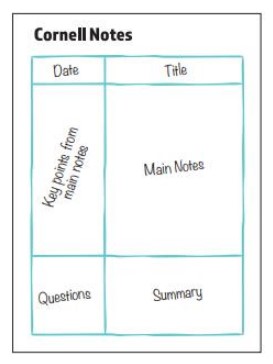
  1. Title (top right). This is really important for revision to ensure you have covered the entire course.
  2. Date (top left). The date when you wrote the notes so you can keep them in order chronologically.
  3. Main Notes (middle right). This is where you put the main thoughts or ideas as you read. Ideally this should be detailed and written in a way that is clearly understood when you are reading it back.
  4. Key Points (middle left). Just after you write the main notes, pick out the key points and jot them down here as short bullets. The bullets should be easily remembered and might only be one word.
  5. Questions (bottom left). This section of the notes is extremely useful. These are areas that aren’t quite clicking and you need to explore further or may be questions that you think of as you study. Your questions should never go unanswered as they take your learning to a deeper place.
  6. Summary (bottom right). Ideally, you shouldn’t be adding your summary on the same day that the notes were taken. Spend some time later on in the week or even at the beginning of the next week reading through your notes and summarising them in this box.
Flashcards are best used for going over topics that you have already learned. If you don’t understand a concept, read the chapter in the book again or watch a video explaining it first. A great habit to get into is using flashcards ‘live’ as you are learning to reinforce the information that you have just gone over. Flashcards are a fantastic tool for testing the gaps in your knowledge: at the start of a study session, give yourself a little test with your cards to identify what areas you should be focusing on.

BrightRED has some fantastic flashcard sets that cover all the key information you need to know; see what subjects we cover on our website here.

Brain dumps are very useful when learning something new. Pick a topic you want to cover and read
it through. Then simply using a blank page, write down everything you can remember. That’s it!
There are a few further ways in which you can use your finished brain dumps as you study.
You can look at your brain dump alongside the pages of the notes or guides and take note of the
things you forgot and go over that material again. You can also do a brain dump on the same topic a
day or two later and compare both to see what you are struggling to recall and then revisit that part
of the textbook. Both these techniques are putting an emphasis on material that didn’t go in the first
time. The process of really focusing on closely reading the topic chosen, and then trying to recall as much as possible right away is what makes the difference.

Dual coding is using different ways to represent the information that you are learning. A large proportion of most books are written as text, so useful things that you can do is take chunks of that text and recreate it in a different way; examples are using simple pictures in a mind map or cartoon strip, a sketch diagram, an infographic, a table or chart or a timeline. The science shows that combining text and images as we learn helps our understanding. Creating the images ourselves can also be a very powerful learning technique.

Mini quizzes are another straightforward technique. As you are reading through your notes, create a
mini quiz of 5-10 questions as you go along. Using an A4 piece of paper or opening a Word document, write your questions on one side and your answers on the opposite page. You can complete this at the end of the reading or give yourself a challenge by waiting for a day or two before completing your quiz.

Top tips.

  • Switch between ideas as you study. Don’t switch too often, though, as you need to make sure you understand the idea before switching!
  • Revising in a different order will also help you understand the information. The technical term for this is interleaving. Just because you have read something once doesn’t mean you will always remember it. That’s why learning how to recall and retrieve information is possibly more important than reading it for the first time.
  • Space out your study and learning. The experts would say that four or five hours spaced over a week is much more beneficial that five hours in one day!
  • Linked to the above point, be organised! Know what it is you have to learn and create a timetable for study. It is highly possible for students who are organised and in charge of their learning to jump up a few grades as they know exactly what they need to learn and have created the time and space to learn it.
  • Find ways to represent the information for yourself. If there is text in this book you want to remember, then why not turn it into an infographic or a cartoon strip? Similarly, if you see a diagram, you can change it into text or bullet points.

GOOD LUCK!
We hope that the study advice we have put together here is useful for you as you get ready to sit the prelims towards the end of the year. Remember that all you can do is give it your best shot, and use it as an opportunity to see how you might improve your grades come the real exams in April. We’re wishing you all the very best of luck!

Getting ready for the new term

And just like that, the summer holidays are nearly over! We hope that you have all managed to take a break from the routine, taking a holiday maybe or even just some time out spent at home. With the recent arrival of exam results and the start of the new term looming, we are sure that for many of you thoughts will be turning to what lies ahead. This is a great time to take a few deep breaths and organise yourself for what’s coming next, so we’ve pulled together some ideas to help get you started.

Thinking about you (and what works for you). Whatever you do during the summer break, the transition back to the regular routine of the school week can be a challenge. Thinking about your personal habits and what works for you to mentally prepare for the new term can be really useful. Routines are hard to come by in the modern world we live in as everything seems to be all go, all the time. It can be hard to pin down a good time to get on with other things or get away from the 24/7.

What’s your routine? Whether on holiday or at school, is there a time of day you feel most productive? Most awake, alert and ready to be doing things? Routines can go out of the window on holidays so if you get a chance to think about when you work best it can be helpful. It is always useful to be well rested – especially in your teenage years – so get into good sleeping habits if you can. Not everyone can do it (and some people are just born night-owls!) but the more quality rest you get the more likely you are to achieve what you need to in the day ahead.

It can be very tempting to have a lazy start to the day but, if you’re able to, sticking as closely as you can to a regular routine will help your days feel structured. Setting your alarm to go off at the same time each day and creating a daily structure featuring work, breaks and workouts can help to establish a routine to make sure you are doing things when you’re most up for them, and this will really benefit your mental and physical health. Once a pattern is set, you will find it easier to get started and use your time efficiently. On days that you don’t have homework or tests to prepare for, keep the routine by doing a little revision or practice questions. Your routine will vary day to day with other commitments but keeping work time as consistent as you can will make a huge difference.

Work is important, but so is downtime. If you have a time of day or periods in the day where you feel you can work best, this must be balanced with things which aren’t work. Taking breaks and time out will balance the harder work and make you much more productive when you need to go back to it. It’s whatever works for you – listen to music, meet friends, do some exercise, watch something completely different. It is crucial that we all take care of ourselves and each other. Thinking about the year ahead, try to anticipate things that will stretch you and stress you so you can prepare for them. With a new term coming up, now is a good time to start thinking about ways of attending to your own individual needs. What’s your best way to relax and escape? Life is mostly busy but things
to do will always be there to come back to – how do you make sure you get the time out that you need? Make sure you have things to do that aren’t school work and commit to doing them as regularly as you can in the weeks and months ahead.

Best places and spaces. Have you found the place where you feel you get the most done? This is both mental and physical. Is it at home alone, in study spaces in school, with friends in other places or in the school or local library? If you can find a place where you can be productive without too many distractions, you are really on to something. For those distractions, try to minimise them as much as you can – especially during your set work times.

How do you steer clear of screens or find quiet (or noisy, if that’s what you like) places where you can focus. Can you switch notifications off for half an hour or forty minutes to give you a spell uninterrupted? Does music help? It all sounds very organised but ten minutes thinking about your ideal place and space to focus can make a big difference when you have things to be getting on with.

A quick review. When thinking about what’s coming up, it could be a good time to do a review of the courses you have completed. This is a useful way to take confidence from all of the ground you have already covered and in how much you have learned already.

Look ahead. Whether you have your exam results or not, have a think about what lies ahead for you in the new term. What subjects have you picked? Which ones are you looking forward to most? Which do you feel you are good or not so good at? This can be a helpful way to mentally prepare for which subjects come to you more easily or to tackle those that stretch you further. Get a sense of what you will be learning in your new courses. No need to start studying just yet – just get a feel for what’s coming up! On a similar theme, is there anything hanging over you from last term that makes you feel a little anxious? Maybe it was working across lots of different subjects, lots of deadlines or certain subjects that had you struggling? Now is a good time to remember that these are memories! Physics might not have been much fun or final marks in French not as good as expected but it is done. A new term lies ahead and it is up to you to decide on your mindset to deal with it.

Set specific goals. Ask yourself one very important question – realistically, what do you hope to achieve in the year ahead? If it is straight As you are after, good habits need to start early and be worked to all year as best you can. Speak to your parents and teachers about everything you can do to make it happen. If you know what marks you need and think you can achieve them without your foot to the floor all year, think about other things you can do to make the most of your time when not studying. It might be a part time job or more time exercising or with your friends. Or just taking things a bit easier!

Set specific goals. Ask yourself one very important question – realistically, what do you hope to achieve in the year ahead? If it is straight As you are after, good habits need to start early and be worked to all year as best you can. Speak to your parents and teachers about everything you can do to make it happen. If you know what marks you need and think you can achieve them without your foot to the floor all year, think about other things you can do to make the most of your time when not studying. It might be a part time job or more time exercising or with your friends. Or just taking things a bit easier!

Make sure you have what you need. Make sure you have your essentials for the year ahead – stationery, books and all other kit. Get plenty of the things that help you along the way so you have a lasting supply and aren’t stuck. There are lots of great offers in the run up to going back to school so keep an eye out for them!

Make time to do the things you love. Hey, this might be maths and, if so – get stuck in! If not, be sure to balance all of your efforts in the year ahead. Whatever gets you out of yourself and away from it all. And look after yourself too – eat well, exercise if you enjoy it, get plenty of rest, see your friends and do plenty of other things that give you joy. Here are some links to have a look at for some useful resources that may help a bit more:
Time Management Techniques – Young Scot
How to Get Confident and Stay that Way! – Young Scot
Tammy’s Techniques – Young Scot
TOP TEN TIPS TO ACTIVE LIVING – DRAFT TL v3 (samh.org.uk)

We hope that you all have a fantastic start to the new term, and are wishing you the very best of luck in your studies!

Textbook Stuff by BrightRED Publishing- English with Dr Chris Nicol

Textbook Stuff by BrightRED Publishing image

This month we launched something new for BrightRED, our new podcast Textbook Stuff. It will shine a light on our Study Guides and offer the inside story on our books.  We have interviewed our expert teacher authors who have spent many months (and sometimes years) writing our Course Books and Study Guides.

Below you will find snippets from the discussion we had with our English author, Dr Chris Nicol. We discussed his frustrations at school and university, his journey to becoming an English teacher, advice for the English course and its exam and finally his career advice that has carried him through his impressive career.

You can find the full transcript here.

Could you tell us a little bit about yourself?

Well, I went to a very good Scottish high school up in Arbroath many many years ago. I enjoyed school but I often got very frustrated by my teachers who were very intelligent men and women. But I often got exasperated by the fact that so many of their nuggets of wisdom were clouded in language that was very opaque which was difficult to get through for a 12- or 13-year-old, so my little hand was always going up in class and there was a lot of sighing from my friends, and the teachers, by asking questions like, ‘Oh what do you mean there? What are you saying?’ It was quite an exasperating process. This frustrating process went on all the way through my education.

Can you tell us about how you transitioned into a teaching career?

I had this idea that teaching might be of interest to me, but I wasn’t going to be a teacher like the ones I’d had at school. So, I took myself off and did a teacher training course and found myself a job in a girl’s public school. I immediately put to work what I learned at my own school that I wasn’t going to be that kind of teacher. I made my lessons directly constructed to talk to the students rather than talk at them and I really enjoyed the process very much.

What is the process of going back and editing your work like?

I think it’s a very very useful device to have someone whose judgement you trust listen to yourself reading it. And be prepared for much more critical comment than you would get if you just handed them a text and asked for their opinion.

How would you suggest students could improve their portfolio writing?

I think also you’ve been picking up a lot of writing skills without knowing it by your work for reading, for understanding, analysis and evaluation. All these techniques you’re pinpointing for the examiners, minor sentences, inversion, figurative language, word choice, parallel structures. You’re ready to talk about them in an exam, so why not make them work for you in your own writing? A lot of students just completely overlooked that they have wonderful techniques in their grasp which they could use to great effect for in their own writing.

And for school leavers what advice do you have if they are unsure what career path they want to take?

I think career wise nothing is set in stone and my own career such as it is, has been a path of serendipity. Really, I’ve always been in the right place at the right time. I have picked up knowledge from all kinds of areas. I haven’t been frightened to change career path when I felt I was getting bored or exhausted by a process. I think the world has many, many opportunities for young people and every job has something to teach you.

If you enjoyed these snippets of our conversation with Dr Chris Nicol you can read the whole transcript here or listen to the podcast here!

Thank you to Chris for taking the time to speak to us and we hope you are looking forward to our podcast guest for next month!

Links mentioned:

New Edition Higher English Study Guide: https://www.brightredpublishing.co.uk/shop/cfe-higher-english

Other Books in the BrightRED English range:

BGE Level 3 English Course book (Publishing March 2023): https://www.brightredpublishing.co.uk/shop/bge-level-3-english

National 4 English Study Guide: https://www.brightredpublishing.co.uk/shop/n4-english

National 5 English Course Book: https://www.brightredpublishing.co.uk/shop/national-5-english-course-book

National 5 English Study Guide: https://www.brightredpublishing.co.uk/shop/n5-english

Advanced Higher English Study Guide: https://www.brightredpublishing.co.uk/shop/cfe-advanced-higher-english

The pandemic and publishing

We were really thrilled to be a sponsor of the SYP Scotland Conference this year and had the opportunity to write a post about how the pandemic has affected our publishing and how we are refreshing our plans and looking ahead to the future. We thought we’d share this post here too so you can find out more about what’s been happening behind-the-scenes over the last year.

Control?

Since the outbreak of the pandemic, the first thing that seemed to disappear for most people was control.  There have been titanic changes to social interactions, approaches to working and how businesses operate.  The publishing industry has not been untouched by this – the effects of COVID-19 have ricocheted throughout our sector, affecting both SME and conglomerate businesses nationwide with disruption permeating everything.  Businesses have been forced to adapt, to reflect on why things have been run in a certain way and question whether they could be run differently in order to survive and flourish.  All in an attempt to take control of what had suddenly become a very uncertain present and challenging future.

Alternate

Small publishers are perfectly placed to change what they do and innovate quickly.  They are also often built on the idea of doing things a little differently.  An ability to alter business models has been crucial for the survival of all publishers during the pandemic. With schools shut, exams cancelled and all learning moved online, Bright Red transitioned to home working and a more digital approach in order to meet the new learning demands. Fast-tracking our digital mindset has been pivotal to navigating through the many, ongoing challenges the pandemic has created. With trade establishments feeling the full force of national lockdowns, having our own online shop and independent warehouse in Fife meant we could continue supplying learning materials to the thousands of students in need of our resources. We approached social media with renewed gusto, highlighting our award-winning (and free) online learning platform that in turn saw an uplift in print sales, which are so crucial for a small, independent, business.

For Scottish publishers, there’s been a definite shift towards becoming digital content creators and experience providers. In educational publishing, there has been an increased demand nationwide for learning material and entertainment for children/young adults and therefore, a call to meet those needs. Posting daily challenges, creating playlists of video content on our YouTube channel and updating our Digital Zone saw a surge of website traffic and sales, and also a wave of appreciation for providing resources that could help students remain on track. With our loyal customer base and support, we reshuffled our publishing plans, focussing on getting our backlist fully updated before we pushed forward with new titles (and exciting new product launches).  

Refresh!

Although schools and shops remain closed (and exams have also been cancelled this year), we are looking forward to the months ahead with renewed hope and continuing with what we do best – publishing high-quality, bespoke books for the Scottish curriculum that fulfil a pressing need. As a small publisher, we are able to publish into niche subjects or subjects that have historically had smaller cohorts, making us stand out from our competitors. Our books are unique in their features and presentation – they put the student at the very heart of the content and we feel that shines from the pages of our books. We are thrilled to be in the process of producing sets of revision cards for National 5 subjects – something new for Scotland and a direct response from teacher feedback.

As Scotland navigates its way out of the pandemic, it is companies that have been able to adapt, to change their outlook and move with the times, utilising the benefits of a digital community, that will be most likely to survive and, ultimately, thrive.

Image of our Revision Cards (the jacket covers which are red for Biology, orange for Chemistry, yellow for Physics and purple for Mathematics and all have jumping outlines of students on them).

How to revise for the SQA exams

Exams coming up? Not sure where to begin with revision? At Bright Red, we understand that the exam period can be a tad daunting. We’ve all been through exams so can fully relate to how you might be feeling and can help give you a gentle nudge in the right direction to help you tackle those exam nerves and help you walk into your exam with confidence.

Here are our top tips to help you revise for your SQA exams:

Start your revision early

The earlier you start revision, the more time you will have to get fully prepared for your examinations. It can be tempting to put off doing revision but starting months in advance and doing a little bit of work each day will allow you to avoid any last-minute, panicked cramming sessions.

Two friends standing next to each other. One friend gesturing and saying 'Always Be Prepared'.
Always be prepared – start your revision early

Plan, plan, plan!

Making a revision timetable can help you visually map out how long you have until your examinations. It can help you plan your time effectively and ensure that you’re allowing yourself revision breaks and some social time too.  You can create a revision timetable in a notebook or by using Word or by using templates online (Get Revising offer a brilliant, free Study Planner template – check it out here).

Boy rolling out plan of action
Create a solid revision plan

Find your study space

Finding a distraction-free space really helps when it comes to getting focused with revision. If you can, choose somewhere that has natural light and where you have plenty of space to spread your notes out and get in the zone. This may be in your bedroom, in the kitchen, at school or in a library. Keeping things nice and tidy around you can help you stay focused and on track with your revision.

Man rubbing his hands together and getting ready to type
Find your space and get in the zone

Use Study Guides

Study Guides are a brilliant way of filling in any gaps in knowledge and consolidating what you’ve learnt in class. We have 65+ Study Guides from N4 – AH level across a huge range of subjects so definitely check out our website here and pick up any Study Guides in subjects that you feel like you need a little extra support in.

Boy with pencil behind his ear, looking over worksheets
Use Bright Red Study Guides and Course Books

Jazz up your notes and use mnemonics!

Add colour and illustrations to your notes – this will make them more visually appealing and will help all that studying stick. Using mnemonics is a good way of shortening your notes and making concepts and facts easier to remember.

Man playing a musical instrument enthusiastically
Jazz up your revision and class notes

Test yourself!

Practice makes perfect – register for our Bright Red Digital Zone which has tonnes of activities (Things to do and think about questions) and tests so you can identify both your strengths and any gaps in knowledge. Past Papers are also a super way of testing yourself and assessing what you do and don’t yet know. Check out the SQA website here.

Girl writing on blackboard
Practice makes perfect with Bright Red

Take breaks

It’s important to take plenty of breaks in order to revise effectively and avoid burning yourself out. It’ll also help you to stay motivated and allow yourself to relax! Try going for a run, watching an episode of your favourite show or simply treating yourself to a cup of tea and a piece of cake.

Hedgehog floating around a bath tub
Take time to relax

Look after yourself

Make sure you’re getting enough sleep each night so you can recharge properly and wake up feeling fresh and alert. Drink lots of water, avoid all-nighters and try and eat as healthily as you can to keep your energy levels up!

Sleepy duck drifting off over class notes
Get enough sleep and look after yourself

Best of luck.

For more top tips and advice on different study techniques, check out our Learn to Learn Study Support Guide. It’s also worth checking out our Twitter and Instagram pages for additional revision tips!